
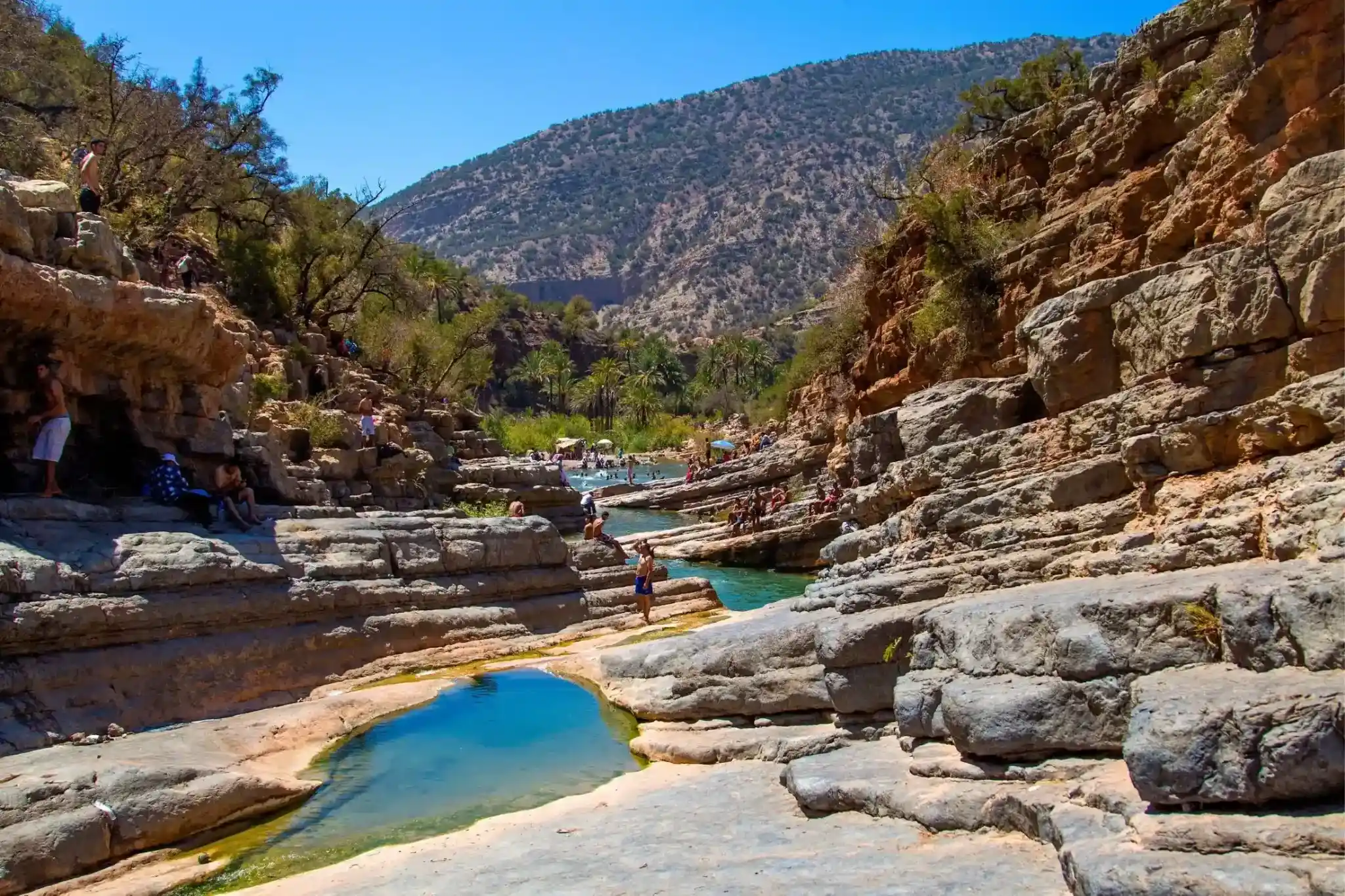

Paradise Valley
Paradise Valley is one of the most popular natural places to visit near Agadir, Morocco. Located in the foothills of the Atlas Mountains, this peaceful valley is known for its rocky landscapes, palm trees, small rivers, mountain villages, and natural swimming spots.
For many travelers staying in Agadir, Taghazout, Tamraght, or nearby coastal towns, Paradise Valley offers a complete change of scenery. In less than a day, the landscape changes from Atlantic beaches and busy streets to mountain roads, argan trees, valleys, and palm-filled walking paths.
Paradise Valley is a great destination for visitors who enjoy nature, short hikes, local landscapes, photography, swimming when conditions allow, and discovering a quieter side of southern Morocco.
Where Is Paradise Valley Located?
Paradise Valley is located inland from Agadir, in the mountainous area around Imouzzer des Ida-Outanane. The drive usually takes around one hour from Agadir, depending on the starting point, road conditions, and stops along the way.
The road toward the valley passes through changing landscapes. Visitors leave the coast behind and travel through countryside areas, mountain roads, small villages, argan tree fields, and rocky valleys.
The journey itself is an important part of the experience. The scenery becomes more dramatic as the road climbs into the mountains, with views of dry hills, green valleys, palm groves, and traditional Amazigh villages.
What Makes Paradise Valley Special?
Paradise Valley is not a large modern tourist attraction. It is a natural mountain area where the main highlights are the landscapes, water channels, rocky trails, palm trees, and peaceful atmosphere.
The valley is especially known for its contrast between dry mountain scenery and green vegetation. Palm trees grow near the riverbed, while rocky hills and cliffs rise around the valley. This mixture creates one of the most recognizable landscapes in the Agadir region.
During periods with enough rainfall, natural pools and streams can be found along parts of the valley. At other times of the year, water levels may be lower, and some pools may be smaller or dry. For this reason, Paradise Valley is best appreciated as a nature and mountain destination, not only as a swimming spot.
Walking Through the Valley
One of the best things to do in Paradise Valley is simply walk through the natural surroundings. The paths usually pass between palm trees, rocks, small streams, and shaded sections of the valley.
The walk is generally suitable for most visitors, although the ground can be uneven in some places. Comfortable shoes are useful because parts of the route can be rocky, dusty, or slippery near water.
Some areas are easy to access, while other parts require more careful walking. Visitors who continue farther into the valley often find quieter viewpoints and more natural scenery away from the busiest sections.
The atmosphere is especially enjoyable in the morning or later in the afternoon, when the temperatures are usually more comfortable and the light is softer for photos.
Can You Swim in Paradise Valley?
Swimming is one of the best-known activities in Paradise Valley, but it depends on the season and water levels.
After rainfall and during wetter periods, some natural pools can be deep enough for swimming. The water is usually fresh and can feel cold, even on warm days. In drier months, the pools may be smaller, shallow, or not suitable for swimming.
Travelers should not expect the exact same water conditions throughout the year. Photos found online often show Paradise Valley during periods when the pools are full and the water is clear. The real experience can look different depending on recent weather, temperature, and the time of year.
Visitors planning to swim should bring swimwear, a towel, water shoes or sandals with grip, and an extra set of clothes. It is also important to be careful around wet rocks, as they can be slippery.
Discover the Palm Groves and Mountain Scenery
Paradise Valley is surrounded by beautiful natural scenery. Palm trees, argan trees, dry hills, rocky cliffs, and small farms create a landscape that feels very different from Agadir’s coastline.
The valley is part of the wider Souss-Massa mountain region, where nature and rural life are closely connected. Along the road and around nearby villages, visitors may see small agricultural areas, local homes, goats, terraces, and traditional countryside landscapes.
The area is also known for aromatic plants and mountain vegetation. Depending on the season, the air can carry the scent of wild herbs, including thyme and lavender-like plants growing in the region.
For photographers, Paradise Valley offers many different types of scenery in one place: mountain roads, palm trees, natural pools, rocky canyons, village life, and wide valley views.
The Honey Road and Imouzzer Area
Paradise Valley is often connected with the mountain region of Imouzzer des Ida-Outanane, an area known for its traditional honey production.
The roads around Imouzzer are sometimes called the Honey Road because of the local beekeeping traditions and the honey produced in the mountain villages. Visitors may find local products such as honey, argan oil, almonds, amlou, and herbal goods along the route.
Amlou is a traditional Moroccan spread made with almonds, argan oil, and honey. It is commonly served with Moroccan bread and is one of the best-known local foods in the Souss region.
The Imouzzer area is also known for its mountain landscapes and seasonal waterfalls. Waterfall flow can vary greatly during the year, especially after dry periods.
Paradise Valley for Families and First-Time Visitors
Paradise Valley can be a good choice for families, couples, solo travelers, and groups visiting Agadir for the first time.
The experience can be adapted depending on what visitors want to do. Some people prefer a short walk followed by time near the water or a café. Others want to spend longer exploring the valley, walking farther along the trails, swimming, and taking photos.
Families with children should choose easy walking sections and pay attention near water and rocky edges. Visitors with limited mobility may prefer the more accessible parts near the entrance rather than longer paths deeper into the valley.
The destination is less about rushing between attractions and more about enjoying the natural environment at a relaxed pace.
Best Time to Visit Paradise Valley
Paradise Valley can be visited throughout much of the year, but the experience changes with the seasons.
Spring is often one of the most pleasant times to visit because temperatures are comfortable and the landscape may be greener after winter rainfall. Water levels can also be better during this period.
Summer can be hot, especially in the middle of the day. A morning visit is usually more comfortable, and swimming can be refreshing when pools are available.
Autumn can also be a good time for walking and sightseeing, with milder temperatures than summer. During winter, the weather may be cooler, especially in the mountains, but the region can be very scenic after rainfall.
Because Paradise Valley depends on natural water conditions, visitors should always check recent local conditions before planning a swim-focused visit.
What to Bring to Paradise Valley
A comfortable visit to Paradise Valley does not require complicated equipment, but a few essentials can make the day much easier.
Bring comfortable walking shoes or sandals with grip, especially if you plan to walk near the water or on rocks. A hat, sunscreen, sunglasses, and drinking water are useful because parts of the valley are open and sunny.
For visitors hoping to swim, swimwear, a towel, and water shoes are helpful. It is also useful to bring a light jacket during cooler months or early mornings in the mountains.
A small bag for personal belongings is recommended, as the paths can be uneven and it is easier to keep your hands free while walking.
Paradise Valley and Local Moroccan Food
A visit to Paradise Valley can also be a chance to enjoy simple Moroccan food in a mountain setting.
Around the valley and nearby villages, visitors may find cafés or small restaurants serving Moroccan tea, fresh orange juice, tagine, couscous, grilled meat, bread, olives, and local honey products.
The food is usually simple, fresh, and connected to the local countryside. A meal near the valley is often one of the most relaxing parts of the day, especially after walking in the sun or spending time near the water.
Moroccan mint tea is commonly served in the area, often with local honey, almonds, or traditional bread.
Combining Paradise Valley With Other Places Near Agadir
Paradise Valley can be visited on its own, but it also combines well with other places in the Agadir and Souss-Massa region.
Some travelers combine the valley with a visit to Taghazout, Tamraght, or the Atlantic coast. This creates a full day that includes mountains, small villages, beaches, and ocean viewpoints.
Others combine Paradise Valley with the Imouzzer area, local honey stops, argan oil cooperatives, or rural Amazigh villages. These combinations are ideal for travelers who want to understand more about the landscapes and traditions outside Agadir.
For visitors staying several days in the region, Paradise Valley offers a good contrast to city tours, beach days, camel rides, quad biking, and excursions to Taroudant, Tiout, or Tafraoute.
A Natural Escape From Agadir
Paradise Valley is one of the best places near Agadir for travelers who want to experience Morocco’s natural landscapes beyond the coast.
With its mountain roads, palm groves, rocky trails, local villages, and seasonal natural pools, the valley offers a peaceful break from the beach and city atmosphere.
Whether the water is high or low, Paradise Valley remains a beautiful place to walk, enjoy mountain scenery, discover rural life, and see another side of the Souss-Massa region.
0 Comment